
High production has yet to translate into a stronger Brazilian presence in the global fruit trade
Brazil is among the world's largest fruit producers, but it accounts for less than 1% of the value of global fruit exports. Trade barriers, phytosanitary requirements, infrastructure constraints, and the concentration of the domestic market help explain the difference.
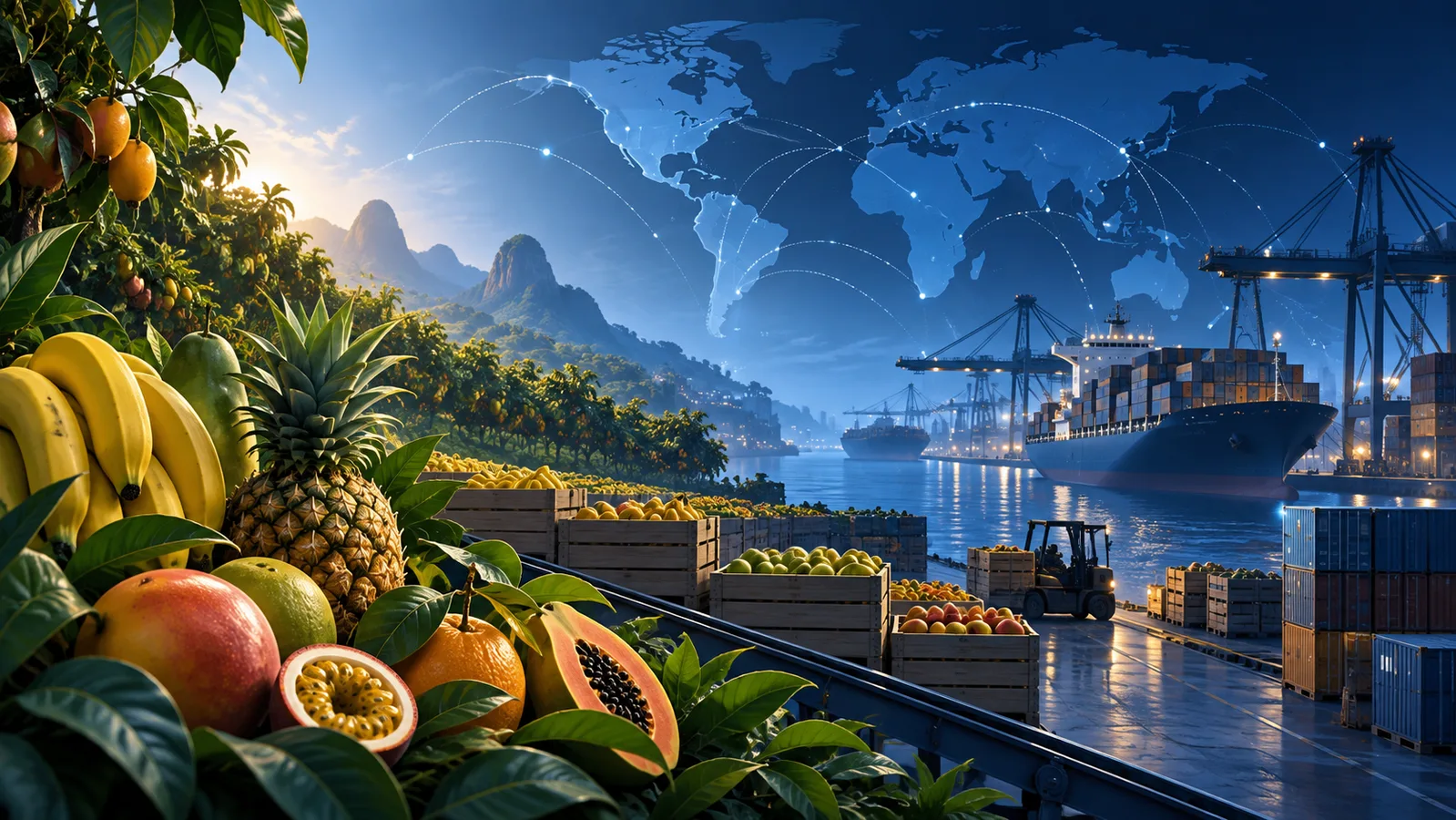
Significant production, limited international share
Brazil ranks third among the world's largest fruit producers, but its participation in the international market remains small. The country accounts for 4.4% of global production and less than 1% of the value of worldwide fruit-sector exports, according to a study by Banco do Nordeste.
The fruit sector is important for generating employment and income, both on commercial farms and in family farming. Most of the cultivated area is in the Northeast, which accounts for approximately 52.4% of Brazil's area devoted to fruit production. The Southeast follows, with almost 26%, driven mainly by citrus production.
Northeast concentrates production and specific exports
The region's most important crops include melons, lemons, mangoes, grapes, cashew nuts, and watermelons. Although the domestic market absorbs most of northeastern production, these fruits have a significant share of exports.
In 2021, the region recorded US$793 million in revenue from fruit exports, while imports totaled US$47.4 million. Pears, grapes, and apples were among the main products purchased from abroad.
Production also has particular importance in some states. In Paraíba, pineapples accounted for half of the value of the state's fruit production in 2021, when the state represented approximately 17% of national pineapple production. In Rio Grande do Norte, melons accounted for 27% of the value of fruit production. In Pernambuco, grapes represented 50.3% of the value produced by the sector, while oranges reached 46.3% in Sergipe.
Europe is the main destination
The European Union was the main market for fresh Brazilian fruit in 2022, receiving 55.4% of the volume exported by the country. For the Northeast, the bloc accounted for 64.9% of shipments.
The Netherlands led as a destination for northeastern exports and served as a gateway to other European markets. In 2022, the country received significant shares of the region's melon, mango, grape, watermelon, and lemon and lime volumes. The Port of Rotterdam plays an important role in this distribution because of its connections with different European countries.
The United Kingdom also received significant volumes of melons, grapes, and watermelons. Spain was another relevant destination for melons and mangoes. Outside Europe, the United States was the main buyer of northeastern cashew nuts and also had a significant share of mango and grape purchases.
Obstacles to export growth
Expanding external sales depends on greater capacity to meet the requirements of importing countries. Obstacles include trade and phytosanitary barriers, a lack of standardization and certification, limited knowledge about exporting, and insufficient infrastructure, especially for sorting and packing.
The supply chain is also influenced by how products are marketed. Many small producers rely on intermediaries to reach food processors, wholesalers, and retailers. This structure facilitates distribution but can generate disputes over prices, payment terms, and loyalty requirements.
In international trade, large trading companies have advantages in post-harvest handling, storage, distribution, and market access. Because the domestic market is large and less demanding, smaller producers may have fewer incentives to export.
Search for new markets
The sector sought to expand its international presence by opening the Chinese market to Brazilian melons through a bilateral agreement signed in 2019. The overlap between Brazil's harvest and China's off-season was identified as a commercial opportunity. However, logistical difficulties associated with the pandemic hindered shipments to China in 2021 and 2022.
Exports also face changes in buyers' requirements. In the European Union, maximum residue limits for pesticides were changed for certain substances, with a focus on protecting pollinators. These rules reinforce the need for producers to adapt and for controls capable of ensuring the compliance of fruit destined for foreign markets.
Source
Banco do Nordeste — ETENE. [Agriculture: Fruit farming](https://www.bnb.gov.br/agroinforma/-/asset_publisher/ji416hA780C3/content/agropecu%25C3%25A1ria-fruticultura/45799)